This section is specific to DriveWorks 24 onwards, for earlier DriveWorks versions please see DriveWorks Pro Server.
Localization
Localization is a feature within DriveWorks Pro Server Groups designed to allow DriveWorks implementations to be localized into multiple languages.
Localization data is managed through the DriveWorks Pro Server web application, and can be accessed within DriveWorks projects by using Localization Functions within Rules.
This is also used throughout DriveWorks CPQ Sales Portal, which currently ships in en-US, however modifying the CPQ and CPQ_Sales_Portal, either by changing the Base Locale Values or adding new Supported Locales will change the values displayed to CPQ Users.
Recommendations
Before implementing localizations we recommend the following:
- Localization is only available for Shared Groups.
The Shared Group must be open and logged in on DriveWorks Pro Server for the necessary securable features to be visible when creating Roles in Security Settings (in DriveWorks Administrator).
- The logged in user must belong to a team that has a role with the following permissions applied:
See Add Role in DriveWorks Administrator - Security Settings for more information.
Target Action Scope Locale Create Team Locale Update Team Locale Delete Team Localization Package Create Team Localization Package Read Team Localization Package Update Team Localization Package Delete Team Localization Package See Anywhere Assigning the Anywhere scope to this action allows a package to be seen on the Localization page when no team has been assigned in the Grant Ownership to Team option when the package was created.
See Creating A Package.
In this topic
Packages
To be able to administer (create, read, update, delete, see) Localization Packages the logged in user must have access to a role that has the necessary Localization Package permissions applied.
See Security Settings for more information.
Any Packages the current user has permission to see will be displayed within the Localization Page in DriveWorks Pro Server, alongside their Base Locale, and any other Locales supported by the Package.
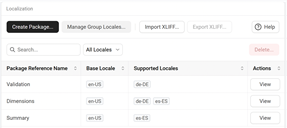
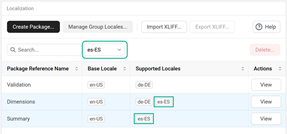
By selecting a Locale from the drop down you can also highlight any Packages within the group supporting this Locale.
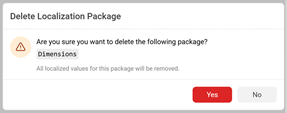
A selected Package can also be deleted from the Group here.
- Select the package from the list.
- Click the Delete button.
- Select Yes on the confirmation dialog.
Creating A Package
From the main Localization page:
- Click the Create Package button.
- In the Create Localization Package dialog enter a Reference Name
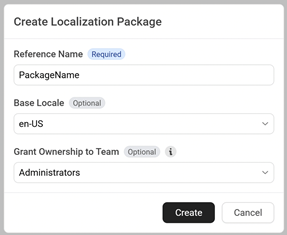
- Optionally select a Base Locale.
- Optionally select a Team from the Grant Ownership to Team field.
This will typically be the team that has Localization Package permissions.
When no team is selected the package will not be visible in the list unless Anywhere scope has been applied to the See action in the permission for the role applied to the team.
See Recommendations above.
- Click Create.
Viewing A Package
Click the Package Reference Name or the View button in the Packages page, to see the contents of a package.
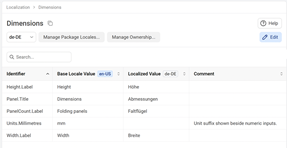
This will display the following:
- Resource Key Identifier
- Base Locale Value
- Localized Value
If a Package has no Supported Locales, this column will not be displayed.
- Comments
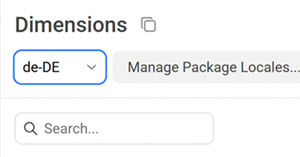
The Supported Locale can be changed in dropdown below the Reference Name.
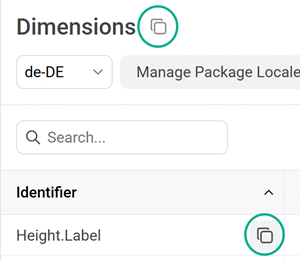
Copy buttons allow the Package Reference Name and Resource Key Identifiers to be copied to the clipboard.
This is useful when consuming the Package within a DriveWorks implementation.
Modifying A Package
Localization Packages can be modified by permitted users within the Package Page by clicking the Edit button.
When a Package is being edited, the selected Supported Locale cannot be changed until either the changes are saved or cancelled.
Renaming A Package
- Click the Edit button next to the Localization Package Reference Name.
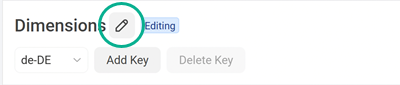
- Enter the new name for the Package.
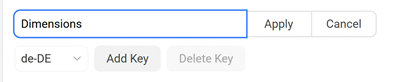
An invalid name will display a warning.
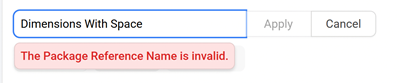
This must be corrected before proceeding.
- Click Apply.
Updating Resource Values
To clear a Base Locale Value or Localized Value:
- Select the value from the list.
- Click the Clear button.

When a Localized Value is (empty) the Base Value will be used as a fallback when getting the Localized data.
To enter a Value that spans multiple lines.
- Select the value from the list.
- Enter the value to appear on the first line.
- For each subsequent new line press shift + enter
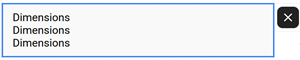
The input will expand to accommodate the additional lines, and collapse back once the change is submitted.
Values that do not fit within the collapsed view, will be shown with an ellipsis (...), for example:

Adding Resource Keys
To add a new Resource Key:
- Click the Add Key button.
A new row will be inserted into the Resource Key package.
The input focus will immediately change to the new Key's Identifier input.
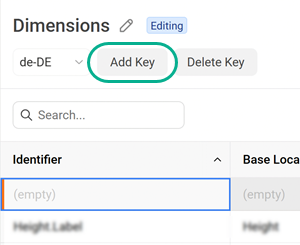
- Enter a value for the Identifier.
The Identifier value:
- Cannot begin with a number
- Cannot contain a space
- Cannot be empty
- Cannot match an existing Identifier value.
Deleting Resource Keys
To delete a Resource Key:
- Select one or more rows to be deleted from the Package page.
- Click the Delete Key button.
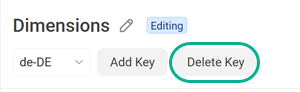
This will mark the key for deletion, it will be deleted once changes are saved.
- Click the Save Changes button.
Please note the following:
- If the Resource Key was created in a previous edit (the change had been saved), the row will be highlighted as deleted, however the Resource Key can be restored back to it's prior state by clicking the Restore Key(s) button.
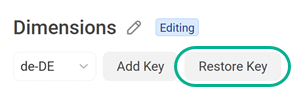
- When a Resource Key is marked for deletion, it cannot be edited.
- If the Resource Key was added in the current edit, it will be permanently deleted.
Saving changes
When the Package has been modified, the Save Changes button will become enabled.
This will also show the total number of modifications made to the Package, and will change color if there are any errors in the modified data.


To revert the current modifications, click the Cancel button.
If there are modifications to be reverted, the following dialog will be displayed.
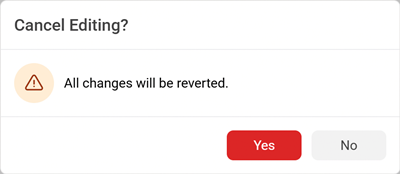
Alternatively, click the Revert Changes button within the Save Changes dialog.
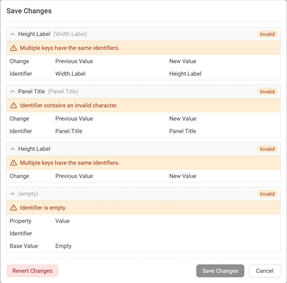
Within the Save Changes dialog all of the changes will be displayed individually, alongside the type of modification that has occurred.
Each row can also be expanded to show more information about the Resource Key that has been modified.
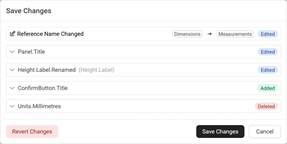
Package Errors will also be shown, alongside the reason for the error.
The changes cannot be saved until these issues are resolved.
Update Reactivity
For performance reasons, Localized Data within DriveWorks Specifications and the CPQ Sales Portal will not update immediately, unless DriveWorks Pro Server is restarted.
Changes may take up to 30 minutes to be reflected.
Import/Export XLIFF
XLIFF is common file format used for localization, and is supported by many localization and machine translation tools.
This allows DriveWorks Localization Packages to be Localized in third party localization tools or by localization services, rather than manually editing the localized values within DriveWorks Pro Server.
DriveWorks uses the XLIFF 2.0 Standard.
This is not designed as a way to backup or transfer packages.
Exporting
Multiple Packages sharing the same Base Locale can be exported simultaneously for a given Target Locale.
XLIFF Files are always exported with the Source Language set to the Base Locale of the Package.
If a Package already supports the Target Locale, the Localized Values for this Locale will also be included in the export.
Any Resource Key comments will be included in the exported file as a note, this can be helpful when working with third party localization providers to describe the purpose of a key, or format strings within the source value.
Importing
Once an exported XLIFF file has been localized, it can be imported back into DriveWorks Pro Server to update the Localization Packages.
Importing cannot create new Packages or Locales within the Group, or new Resource Keys within a Package.
Modifications to the Source Language or notes within the XLIFF file will not be imported.
Any warnings with the XLIFF file will be displayed.
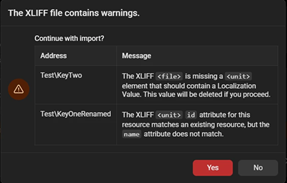
(Note image shown captured in dark mode.)
Certain warnings are recoverable, such as a key being renamed or missing (this may happen if Resource Keys or Packages have been added or renamed since the file was exported).
Other issues are treated as errors, these must be corrected before proceeding.
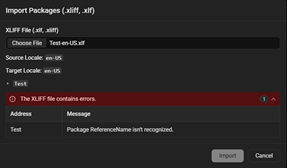
(Note image shown captured in dark mode.)
Errors could include Resource Key or Localization Package not being recognized (this may happen if Resource Keys or Packages have been deleted since the file was exported).
This is designed to help prevent data loss.
Locales
To be able to administer (update, delete) locales the logged in user must have access to a role that has the necessary Locale permissions applied.
See Security Settings, Role Permissions - Locale for more information.
Managing Locales Within A Group
Group locales are administered from the Localization page.
Viewing Locales
From the Localization page:
- Click Manage Group Locales.
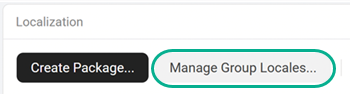
- This displays all Locales in the group.
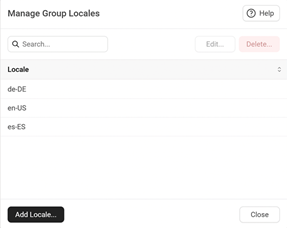
From here group locales can be:
Adding Locales
From the Manage Group Locales dialog:
- Click the Add Locale button.
- Enter the Locale Tag in the Locale Tag field.
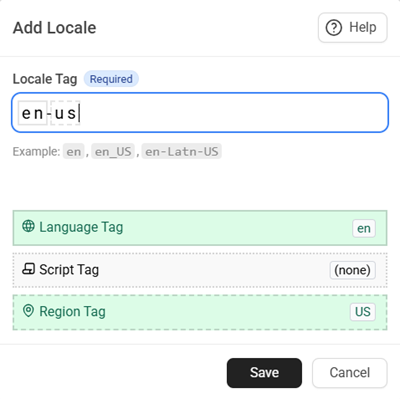
- Click the Save button.
A Locale Tag comprises a Language Tag and the following optional sub-tags:
- Script Tag
- Region Tag
- Variant Tag (can be included, but are not highlighted or respected in Locale matching)
Each sub-tag is required to be separated with - (dash) or _ (underscore).
The Locale Tag field will highlight each tag with a corresponding border outline type.
- Language Tag = solid border
- Script Tag = dotted border
- Region Tag = dashed border
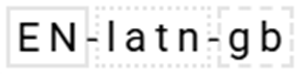
Tags are also put into their canonical form, including converting extended language tags, and casing each appropriately.
For example values entered in the Locale Tag field will be converted or cased into their respective fields:
- EN becomes en
- latn becomes Latn
- gb becomes GB
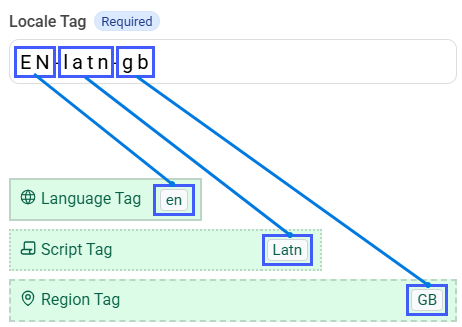
Any errors with the Locale Tag are clearly indicated in the Add Locale dialog.
See Locale Tags for more information.
Editing Locales
From the Manage Group Locales dialog:
- Select the locale to be modified
- Click the Edit button.
- Make the change to the Locale Tag field in the Edit Locale dialog.
Modifications to the locale tag are displayed in the corresponding sub-tag field giving a visual feedback before the changes are committed.
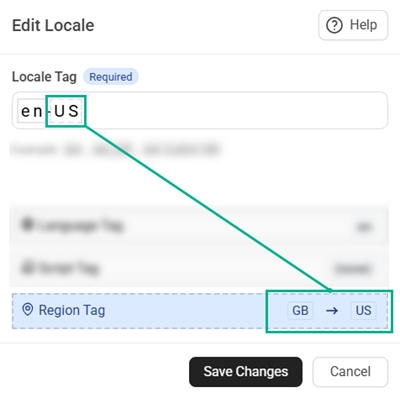
- Click Save Changes.
Deleting Locales
Deleting a Locale will delete it from the group entirely.
From the Manage Group Locales dialog:
- Select the locale to be deleted.
- Click the Delete button.
When a locale is deleted from a group, all Localized Resources for the Locale will also be deleted.
- A list of affected Packages is displayed in the Delete Locale from Group confirmation dialog.
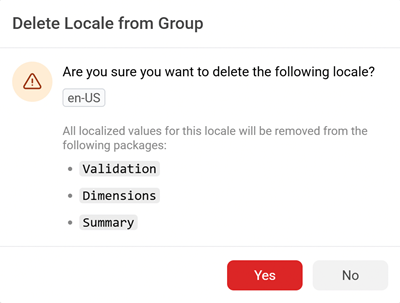
Click Yes to confirm deletion.
Managing Locales Within A Package
Locales applied to a Package are administered from the Package page.
Viewing Locales
From the Packages page:
- Click Manage Package Locales.
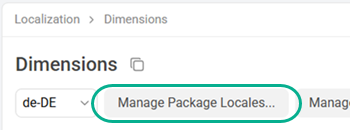
- The Manage Package Locales dialog shows all locales currently supported by the Package.
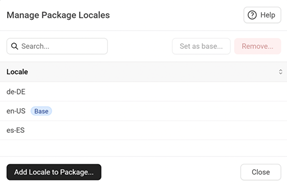
This indicates the current Base Locale.
- Click Close to return to the Packages page.
Adding Locales To A Package
From the Manage Package Locales Dialog:
- Click the Add Locale to Package button.
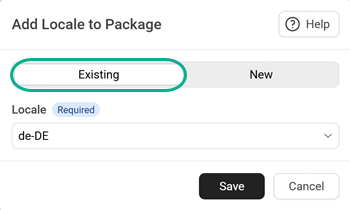
- Select Existing or New
- Existing
Select the existing locale tag from the Locale field.
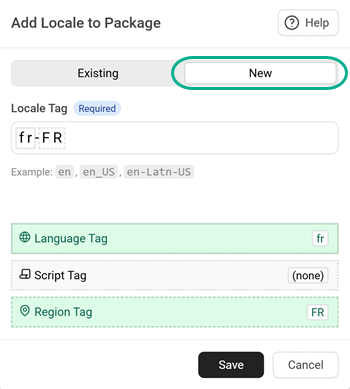
- New
Enter the new locale tag in the Locale Tag field.
See Adding Locales for more information about Locale Tags and the editor.
- Existing
- Click Save.
Change Base Locale
This is useful when localizing CPQ for instance, when updated packages in a locale other than en-US are exported as XLIFF files based on this updated data.
As the base is used as the fallback for any missing values within supported locales, ensure the base locale has been completely localized.
From the Manage Package Locales Dialog:
- Select a locale (that is not currently the base locale).
- Click Set as base.
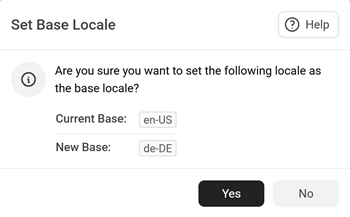
This displays a confirmation dialog where the Current Base and the New Base that will be applied.
- Click Yes in the Set Base Locale confirmation dialog.
Removing Locales
Removing a Locale will remove it from the package only.
From the Manage Package Locales Dialog:
- Select the locale to be removed.
- Click the Remove button.
- Click Yes in the Remove Locale from Package confirmation dialog.
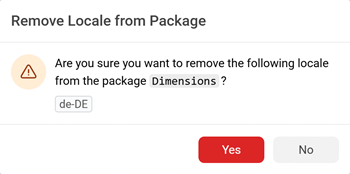
The removed locale will no longer be supported by the package.
Localized values will be deleted in the Package for that Locale.
Locale Tags
When creating locales the following should be observed.
| Tag | Required | Description | Format |
|---|---|---|---|
| Language Tag | Required | This is the Language used by the Locale.
For example:
|
|
| Script Tag | Optional
Included in matching | The writing system/script used by the Locale.
For example:
|
|
| Region Tag | Optional
Included in matching | Indicates any regional variation of the Locale.
For example:
|
|
| Variant Tags | Optional
Not included in matching | Describes a specific variant of the Language.
For example:
|
|
Locale Matching
When selecting the supported locale to use, DriveWorks uses Distance-Based locale matching, based on the CLDR language/script/region distance data.
For example:
{
    "Desired": {
        "LanguageTag": "ca"
    },
    "Supported": {
        "LanguageTag": "es"
    },
    "Distance": 20,
    "IsOneWay": true
},
This determines that ca (Catalan) has a distance of 20 to es (Spanish), compared to the standard distance of 50.
So if a user has their machine set to ca it will try to access a Package supporting es and en-ES (base), it will prefer es.
This is only one way, meaning if a user with their machine set to es tries to access a Package supporting ca and en-ES (base), it would prefer the Base Locale.
Prior to this distance match, DriveWorks will canonicalize the locales supported by the Package and in the user's Accept-Language request header (Current Client Languages special variable).
This is designed to ensure equivalent Locales are treated the same as one another in the matching process.
For example en is equivalent to en-Latn-US, as defined by the LikelySubtags in the CLDR, and eng is equivalent to en as defined by LanguageAliases.
This also means that if these equivalent Locales exist within a group that is supported by a package, there is no defined logic for which should take precedence.
DriveWorks also supports "quality values" in the clients Accept-Language header to influence the distance matching.
For example, the client could have the header:
fr-CH, en;q=0.8, fr;q=0.6
This means Swiss French takes precedence, but English is weighted higher than other French Locales.
If no quality values are set, the order of precedence is influenced by which value occurs first.
The user typically wouldn't set this manually, but is managed through their browser/OS language settings.
For example the Languages set below in Microsoft Edge resulted in the Accept-Header:
en-GB,en-US;q=0.9,en;q=0.8,es-MX;q=0.7,es;q=0.6.
When running a specification through DriveWorks Administrator, the Accept-Header used will typically just be the Windows Languages, in order, with no quality.
The example below will return:
en-US,en-GB.
A slimmed down version of the CLDR is supplied with DriveWorks, and compiled for faster usage in Locale Matching.
It is unlikely this will change drastically enough to require modifying.
However it can be overwritten by placing the CLDR archive, entitled cldr.zip located in
C:\Users\<USER>\AppData\Local\DriveWorks\Cldr
(on the machine DriveWorks Pro Server is installed)
This will be read on startup and converted into a cache.jsonfile.
The cache file will be loaded instead of the CLDR archive unless it is deleted.
The archive should have the structure:
- cldr.zip
- common
- supplemental
- languageinfo.xml
- likelySubtags.xml
- supplementalData.xml
- supplementalMetadata.xml
- supplemental
- common
Permissions
Package Permissions
Localization Packages have five Permission action types:
- Create - Create new Localization Packages
- See - See the Package and it's supported Locales within the Packages list
- Read - See permission + the ability to read the contents of the Package
- Update - Edit the contents of a Localization Package, add/remove Resource Keys, add/remove Supported Locales, Set Base Locale, Rename the Package
- Delete - Delete a Localization Package and all of its resources
These Permissions respect Scope, which evaluates whether the Localization Package is “owned“ by the given Team, or its parents
Locale Permissions
Locales have three Permission action types:
- Create - Create new Locales
- Update - Edit the Locale Tags of a Locale
- Delete - Delete a Locale, and any Localized Resources in Packages supporting the Locale. This should be carefully allocated, given the wide scope of potential changes.
Locales can be read by any user, as they are not treated as sensitive data.
Scope should not impact these permissions, as Locales cannot be owned.
Managing Ownership
Ownership can either be granted to a Team when the Package is created (this only requires the Create permission), or through the Manage Ownership dialog in the Package Page (this requires Administer Group Security, rather than a Package Permission).
A User not directly in a Team may have access to Package if the Team they are in is a child of a Team that has Ownership, rather than being in the owning Team itself.
DriveWorks Functions
The following DriveWorks functions will be included in Projects within DriveWorks Pro Server Shared Groups:
GetLocalizationPackages
Returns a Table containing the Localization Packages the user has permission to See, and their supported Locales as a pipe-separated list.
Syntax
GetLocalizationPackages()
Example
| Rule | Meaning |
|---|---|
| GetLocalizationPackages() | Will return a table containing the Localization Packages the user has permission to. |
Example Outcome
The result will be returned as an array, which will look like:
{"Localization Package","Supported Locales";"CPQ","en-US|es-ES"}
When viewed as a table:
| Localization Package | Supported Locales |
|---|---|
| CPQ | en-US|es-ES |
GetLocalizationPackage
Returns a Table containing the Resource Key Identifiers in the Package, and their corresponding Localized Value in the matched Locale. This will include fallbacks to the Base Locale wherever a value is empty in the matched Locale.
Syntax
GetLocalizationPackage(Package Name, [Locales])
Where:
Package Name - is the Reference Name of the Package to retrieve
Locales (optional) - is a comma separated Language-Accept header to match against when retrieving the localized data.
If no Locales are specified, the Current Client Languages value will be used.
Example
| Rule | Meaning |
|---|---|
| GetLocalizationPackage("CPQ") | Will return the Resource Key Identifiers from the CPQ package using the current client languages value. |
Example Outcome
The result will be returned as an array, which will look like:
{"Identifier","Localized Value";"QuoteCommentRevision.QuoteComment.TooltipText","","AccountPrimaryContact.Account.DisplayName","Account"}
When viewed as a table:
| Identifier | Localized Value |
|---|---|
| QuoteCommentRevision.QuoteComment.TooltipText | |
| AccountPrimaryContact.Account.DisplayName | Account |
GetLocalizedResource
Returns the Localized Value of the matching Resource for the matching Locale, based on the Current Client Language value.
Fallbacks to values in the Base Locale of the Package take precedence over the Fallback value specified here.
Syntax
GetLocalizedResource(Package Name, Resource Identifier, [Fallback Value])
Where:
Package Name - is the Reference Name of the Package to retrieve the resource from.
Resource Identifier - The Resource Key Identifier of the resource to retrieve
Fallback Value (optional)- If the Package or Resource Key cannot be found in the group, or the value is un-set, this value will be returned. If no fallback is specified, an error will be returned.
Example
| Rule | Meaning |
|---|---|
| GetLocalizedResource("Dimensions","Width.Label") | Will return the localized value for the identifier Width.Label from the Dimensions package based on the Current Client Language value. |
Example Outcome
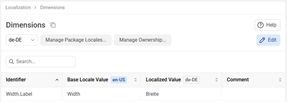
The image below is an extract from the Dimensions package, showing the Identifier Width.Label
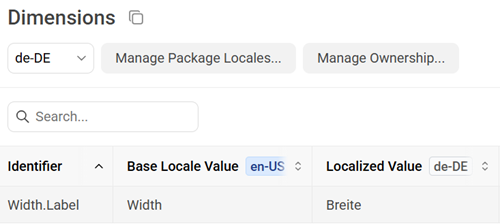
For a machine where the current client language value is en-US the example will return:
Width
For a machine where the current client language value is de-DE the example will return:
Breite
GetLocalizedResourceByLocale
Returns the Localized Value of the matching Resource for the matching Locale, based on the supplied Locales value
Syntax
GetLocalizedResourceByLocale(Package Name, Resource Identifier, Locales, [Fallback Value])
Where:
Package Name - The Reference Name of the Package to retrieve the resource from
Resource Identifier - The Resource Key Identifier of the resource to retrieve
Locales - A comma separated Language-Accept header to match against when retrieving the localized resource
Fallback Value (optional) - If the Package or Resource Key cannot be found in the group, or the value is un-set, this value will be returned. If no fallback is specified, an error will be returned.
Example
| Rule | Meaning |
|---|---|
| GetLocalizedResourceByLocale("Dimensions","Width.Label","en-US, de-DE") | Will return the localized value for the identifier Width.Label from the Dimensions package based on the Current Client Language value. |
Example Outcome
For a machine where the current client language value is en-US the example will return:
Width
For a machine where the current client language value is de-DE the example will return:
Breite
Integration With Business Objects
This applies to Package Modifiers.
When a Business Object Package has a Reference Name matching a Localization Package, they are treated as related, and an indicator will appear allowing navigation between the Business Object Package and the Localization Package.
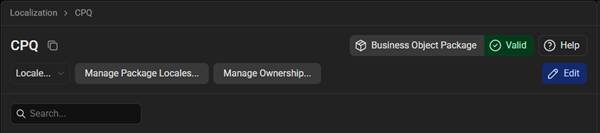

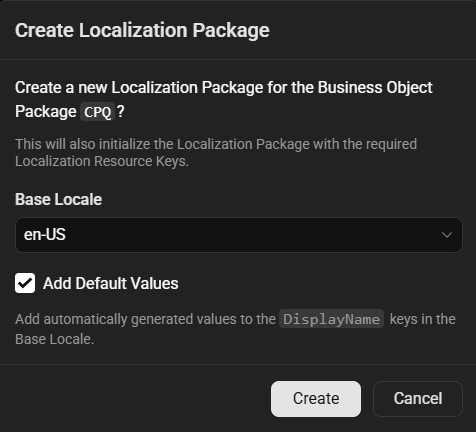
If a Business Object Package does not have a corresponding Localization Package, it will present an option to generate a new one. This will generate all of the required Resource Keys to Localize the object.
A Base Locale can be set for the new Package, and this then allows the DisplayName Values to be pre-populated based on the Business Object Package Reference Names.

Package Updates
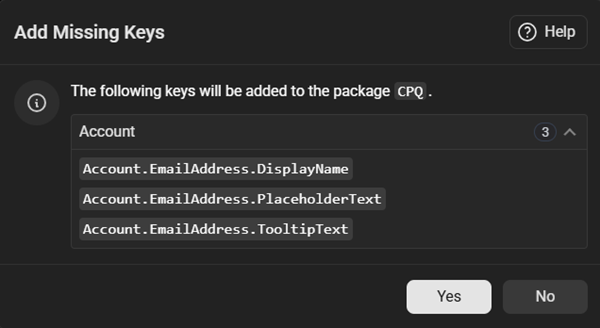
When a Package is updated, for example adding new Attributes to a Business Object using a Package Modifier, the Business Object indicator will show a warning of any keys missing from the package.
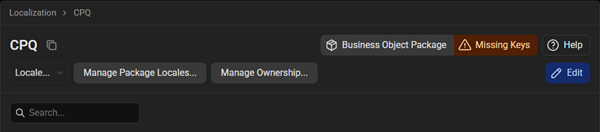
Clicking this will show the missing keys, and give the option to add them to the Package.
If a Required Value is empty, the indicator will display Missing Values.
The unique name used to retrieve a Package within the Group.
The unique name used to retrieve a Package within the Group.
The unique name used to retrieve a Resource Key within a package.
The keyed item within a Localization Package which localized values are mapped to. A Key can have a comment, and different Localized Values corresponding to each supported Locale.
The keyed item within a Localization Package which localized values are mapped to. A Key can have a comment, and different Localized Values corresponding to each supported Locale.
The keyed item within a Localization Package which localized values are mapped to. A Key can have a comment, and different Localized Values corresponding to each supported Locale.
The keyed item within a Localization Package which localized values are mapped to. A Key can have a comment, and different Localized Values corresponding to each supported Locale.
The keyed item within a Localization Package which localized values are mapped to. A Key can have a comment, and different Localized Values corresponding to each supported Locale.
XML Localisation Interchange File Format, the format used for exporting/importing localized resources for a Localization Package.
XML Localisation Interchange File Format, the format used for exporting/importing localized resources for a Localization Package.
The keyed item within a Localization Package which localized values are mapped to. A Key can have a comment, and different Localized Values corresponding to each supported Locale.
XML Localisation Interchange File Format, the format used for exporting/importing localized resources for a Localization Package.
XML Localisation Interchange File Format, the format used for exporting/importing localized resources for a Localization Package.
XML Localisation Interchange File Format, the format used for exporting/importing localized resources for a Localization Package.
The keyed item within a Localization Package which localized values are mapped to. A Key can have a comment, and different Localized Values corresponding to each supported Locale.
A keyed collection of localized text resources, where the retrieved value is determined by which Locale is selected.
The text string used to identify a locale, described by IETF BCP 47.
The Unicode Common Locale Data Repository, a project/data set describing globalization information.
The Unicode Common Locale Data Repository, a project/data set describing globalization information.
The Unicode Common Locale Data Repository, a project/data set describing globalization information.
The Unicode Common Locale Data Repository, a project/data set describing globalization information.
A keyed collection of localized text resources, where the retrieved value is determined by which Locale is selected.
A keyed collection of localized text resources, where the retrieved value is determined by which Locale is selected.
A keyed collection of localized text resources, where the retrieved value is determined by which Locale is selected.
Relates to Team Permissions/Security, if a Package is owned by a Team, it will be included within any of the team-scoped permissions of Roles in the owning Team, or Roles assigned to Users within that Team.
Relates to Team Permissions/Security, if a Package is owned by a Team, it will be included within any of the team-scoped permissions of Roles in the owning Team, or Roles assigned to Users within that Team.
The unique name used to retrieve a Resource Key within a package.
The unique name used to retrieve a Resource Key within a package.
The keyed item within a Localization Package which localized values are mapped to. A Key can have a comment, and different Localized Values corresponding to each supported Locale.
The unique name used to retrieve a Resource Key within a package.
The keyed item within a Localization Package which localized values are mapped to. A Key can have a comment, and different Localized Values corresponding to each supported Locale.
A keyed collection of localized text resources, where the retrieved value is determined by which Locale is selected.
A keyed collection of localized text resources, where the retrieved value is determined by which Locale is selected.
A keyed collection of localized text resources, where the retrieved value is determined by which Locale is selected.
- Welcome
- What's New
- DriveWorks 24
- Older Versions
- DriveWorks 23
- DriveWorks 22
- DriveWorks 21
- DriveWorks 20
- DriveWorks 19
- DriveWorks 18
- DriveWorks 17
- DriveWorks 16
- DriveWorks 15
- DriveWorks 14
- DriveWorks 12
- What's New DriveWorks 12
- Form Design
- Rule Builder
- Tables
- Documents
- Model Rules
- Specification Test Mode
- Specification Explorer
- 3D Preview
- DriveWorks Live
- DriveWorks Add-in for SOLIDWORKS
- DriveWorks 11
- What's New DriveWorks 11
- DriveWorks Administrator
- DriveWorks Add-in for SolidWorks
- DriveWorks Package
- Settings
- Clear Recent List
- Task Status
- Renaming Controls and Variables
- Rule Builder
- Group Tables
- Form Design
- Documents
- Model Rules
- Specification Macros
- Toolbox
- DriveWorks Autopilot
- DriveWorks Live
- DriveWorks 3D Workshop
- DriveWorks Pro Server
- Installation
- Licensing
- DriveWorks 10
- DriveWorks 9
- DriveWorks 8
- Installation
- DriveWorks Administrator
- DriveWorks Data Management Tool
- DriveWorks Live
- Administrator
- DriveWorks Administrator
- Before You Begin
- Using DriveWorks Administrator
- Using DriveWorks Administrator
- SolidWorks
- SOLIDWORKS
- Captured Models
- Part Mode
- Assembly Mode
- Drawing Mode
- Model Generation
- New Specification
- Project Designer
- Project Designer
- Stage 1: Group Setup
- Stage 2: User Interface
- Form Navigation
- CPQ-CustomItem Template
- Form Design
- Form Design
- 3D Preview Box
- Check Box
- Check Box Group
- Child Specification List
- Clipboard Button
- Combo Box
- Data Grid
- Data Table
- Date Picker
- Dialog Button
- Frame Control
- Hyperlink
- Item List
- Label
- List Box
- Macro Button
- Measurement Text Box
- Numeric Text Box
- Option Button
- Option Group
- Picture Box
- Slider
- Specification Host
- Spin Button
- Text Box
- TinyMCE Control
- Toggle Switch
- Upload Control
- Web Frame
- Form Messages
- Stage 3: Data and Rules
- Stage 4: Output Rules
- Documents - Files
- Documents - Data
- Documents - 3D
- DriveWorks 3D File
- Rotation And Orientation
- Environment
- Assets
- Nodes
- Guides and Best Practices
- Model Rules
- Generation Tasks
- Generation Tasks
- Generation Task Toolbox
- General
- Assembly
- Assembly & Drawing
- Drawing
- Activate Sheet
- Auto Arrange Dimensions
- Auto Balloon View
- Create General Table
- Create Sheet Images
- Delete Dangling Dimensions
- Drive General Table
- Insert Note
- Re-jog Ordinate Dimensions
- Replace View Component Reference
- Rescale And Position View
- Set Annotation Position by Percentage
- Set Annotation Position by Distance
- Set Annotation Positions by Percentage
- Set Annotation Positions by Distance
- Set Display Style of Views
- Setting: Hide Dangling Dimensions
- Set View Relative Position
- File System
- Part
- Part & Assembly
- PDMPro
- PDMPro: Change the State of a File
- PDMPro: Check Out File
- PDMPro: Check Out Folder Content
- PDMPro: Check In File
- PDMPro: Check In Folder Content
- PDMPro: Clear Local Cache From Folder
- PDMPro: Clear Local Cache For File
- PDMPro: Create Folder
- PDMPro: Delete File
- PDMPro: Get Latest File
- PDMPro: Get Latest Files
- PDMPro: Get Latest Files in Folder
- PDMPro: Get Specific File Version
- PDMPro: Update File Data Card
- PDMPro: Update Folder Data Card
- Specification
- Generation Tasks - Condition Editor
- Generation Task Condition Toolbox
- Specification Conditions
- Generation Conditions
- Stage 5: Specification Control
- Specification Settings
- Specification Properties
- Specification Macros
- Specification Flow
- Toolbox
- Toolbox
- Tasks
- 3D
- Calculate Bounding Box Data
- Calculate Estimated Volume Data
- Create Preview Image
- Delete Document Appearance
- Delete Document Decal
- Delete Document Node
- Duplicate Document Appearance
- Duplicate Document Decal
- Duplicate Document Node
- Export 3D as gITF
- Export 3D as OBJ
- Export 3D as STL
- Export Smoothed 3D
- Import 3D Document
- Get Document Node Transform
- Get LookAt Rotation
- Import glTF as 3D
- Import OBJ as 3D
- Import STL as 3D
- Run 3D Preview
- Save 3D Document
- Set Document Entity Suppression State
- Set Document Node Static Transform
- Suffix 3D Asset Names
- XR Session Exit
- Autopilot
- Browser Navigation
- Data
- Clear Deferred Flag For Drawings
- Clear Deferred Flag For Specification Drawings
- Create Project Metadata
- Delete Calculation Table Rows
- Delete Group Table Rows
- Delete Simple Table Rows
- Drive Constant Value
- Drive Control Value
- Enable OnDemand
- Evaluate Rule Value
- Get Constant Value
- Get Control Value
- Refresh Tables
- Regenerate and Delete Component
- Regenerate and Delete Specification Components
- Regenerate and Overwrite Component
- Regenerate and Overwrite Specification Components
- Release Documents
- Release Emails
- Release Models
- Send HTTP Request
- Set Project Meta Data Value
- Set Triggered Action States To Trigger On
- Update Group Table Using Array
- File System
- General
- PDF
- PDF: Add Page Stamps
- PDF: Add Watermark Image
- PDF: Add Watermark Image With Autofill
- PDF: Add Watermark Text
- PDF: Add Watermark Text With Autofill
- PDF: Image(s) to PDF
- PDF: Markdown File to PDF
- PDF: Merge
- PDF: PDF to Image(s)
- PDF: Remove Document Info
- PDF: Remove Metadata
- PDF: Remove Page Stamps
- PDF: Remove PDF Pages
- PDF: Replace Keyword
- PDF: Rotate Page(s)
- PDF: Set Document Info
- PDF: Set Metadata
- PDF: Split
- PDMPro
- PDMPro: Change the State of a File
- PDMPro: Check in File
- PDMPro: Check In Folder Content
- PDMPro: Check Out File
- PDMPro: Check Out Folder Content
- PDMPro: Clear Local Cache From Folder
- PDMPro: Clear Local Cache For File
- PDMPro: Create Folder
- PDMPro: Delete a file from vault
- PDMPro: Delete Folder
- PDMPro: Get History for a File
- PDMPro: Get Latest File
- PDMPro: Get Latest Files
- PDMPro: Get Latest Files In Folder
- PDMPro: Get Latest Specification Documents
- PDMPro: Get the Configurations for a file
- PDMPro: Get the File Data Card Values
- PDMPro: Get the File Information for a file
- PDMPro: Get the Folder Data Card Values
- PDMPro: Get Multiple Serial Numbers
- PDMPro: Get Next Serial Number
- PDMPro: Get Specific File Version
- PDMPro: Update File Data Card
- PDMPro Update Folder Data Card
- Security
- Add New Team
- Add New User
- Add User To Team
- Delete Team
- Delete User
- Enable/ Disable User
- Remove User From Team
- Set All Teams Can Run DriveApp
- Switch Team Leader Status
- Update Team Display Name
- Update Team Members Can Capture
- Update Team Members Can Edit All Specifications
- Update Team Members Can Edit DriveApps
- Update Team Members Can Edit Group Security
- Update the Team/Project Permissions
- Update User Display Name
- Update User Email Address
- Update User Password
- Services
- Specification Hosting
- Specification Upgrade
- Specifications
- Archive Specification
- Cancel Specification
- Change Child Specification State
- Complete Child Specification
- Copy Closed Child Specification
- Copy Closed Specification
- Copy Specification
- Create Closed Child Specification
- Delete Specification
- Export Specification Data
- Increment Revision Number
- Invoke Child Specification Operation
- Invoke Child Specification Transition
- Invoke Operation on Existing Specification
- Invoke Specification Operation
- Invoke Specification Transition
- Invoke Transition on Existing Specification
- Set Specification Owner
- Start Child Specification
- Store Specification
- Conditions
- Stage 6: Specification
- Specification Explorer
- Personal Web Edition
- Stage 7: DriveApps
- DriveApps
- Dashboard DriveApp
- CPQ DriveApp
- Scheduler DriveApp
- Settings
- Rules Builder
- Rules Builder
- Extract Variable
- Edit Variable
- Rule Builder Settings
- Writing Rules
- Writing rules
- Document Rules
- Model Rules
- Parts and Assemblies
- Model Rules Overview
- Model Rules
- Advanced Feature Parameter Rules
- Model Rules Advanced Feature Parameter Rules - Overview
- Boss/Base Features
- Boss/Base Thin
- Break Corner
- Chamfer
- Circular Component Pattern
- Circular Pattern
- Coordinate System
- Cosmetic Thread Features
- Curve
- Curve Driven Pattern
- Curve Through XYZ Points
- Cut Features
- Distance Mate Features
- Draft
- Edge Flange
- Features
- Fillet
- Hole Wizard Features
- Linear Component Pattern
- Linear Pattern
- Lofted Bend
- Mates
- Mold Features
- Offset Surface
- Pattern Driven Component Pattern (Derived)
- Patterns with Advanced Feature Parameters
- Revolved Boss/Base
- Revolved Boss/Base Thin
- Rib
- Ruled Surface
- Sheet Metal Features
- Simple Hole
- Sketch Driven Pattern
- Slot Mate
- Surface Features
- Sweep Thread
- Table Driven Pattern
- Var Fillet
- Weldment Features
- Wrap
- Drawings
- Functions
- Functions
- 3D
- Conversion
- Cryptography
- Database
- Date and Time
- ConvertFromUtc
- ConvertToUtc
- Date
- DateAddDays
- DateAddHours
- DateAddMilliseconds
- DateAddMinutes
- DateAddMonths
- DateAddSeconds
- DateAddWeeks
- DateAddYears
- DateTime
- DateTimeLocal
- DateTimeSpan
- DateValue
- Day
- GetTimeZones
- Hour
- Minute
- Month
- NetWorkDays
- NetWorkDaysCustom
- Now
- NowUTC
- Second
- TimeValue
- Today
- UnixEpoch
- Weekday
- WeekNum
- WorkDay
- WorkDayCustom
- Year
- File System
- Group
- Helper
- Lambda
- List
- Logical
- Math
- PDF
- PDMPro Plugin
- Polygon
- Security
- Specification
- Table
- CountIF
- CSVFromTable
- Dcount
- DMax
- DMin
- DWHLookup
- DWVLookup
- GetData
- GetTableValue
- HLookup
- ListAll
- ListAllConditional
- ListAllConditionalDistinct
- ListAllDistinct
- SumTableColumn
- TableAppendColumns
- TableAppendRow
- TableAppendRows
- TableAverage
- TableBreak
- TableColumn
- TableColumnLookup
- TableCombine
- TableDistinct
- TableDistinctCount
- TableDistinctSum
- TableFilter
- TableFilterAll
- TableFilterByList
- TableFormat
- TableFormatInvariant
- TableFromCsv
- TableFromList
- TableGetColumnCount
- TableGetColumnIndexByName
- TableGetDataRows
- TableGetHeaderRow
- TableGetRowCount
- TableGetRows
- TableGetValue
- TableJoin
- TableMax
- TableMaxValue
- TableMin
- TableMinValue
- TableRemoveBlankColumns
- TableRemoveBlankRows
- TableRemoveColumn
- TableRemoveRow
- TableReplaceHeaderRow
- TableReplaceHeaders
- TableReplaceRow
- TableReverse
- TableRow
- TableSearch
- TableSelectColumns
- TableSequence
- TableSkipRows
- TableSort
- TableSortByDate
- TableSortByList
- TableSubstitute
- TableSum
- TableTakeRows
- TableTranspose
- TableWithSequence
- VLookup
- Text
- Validation
- Variables
- Vector
- Group Wizards
- Project Wizards
- 3D Viewer
- User
- DriveWorks User
- Before You Begin
- Using DriveWorks User
- With SOLIDWORKS
- Task Explorer
- Stage 1: Specification
- Stage 2: DriveApps
- Settings
- Group Wizard
- Autopilot
- DriveWorks Autopilot
- Before You Begin
- Using DriveWorks Autopilot
- Task Explorer
- Autopilot
- Model Explorer
- Connectors
- Stage 1: Specification
- Stage 2: DriveApps
- Settings
- Group Wizard
- Import Specifications
- Live
- DriveWorks Live
- Before You Begin
- Using DriveWorks Live
- Stage 1: Specification
- Stage 2: DriveApps
- Stage 3: IIS
- Settings
- Group Wizard
- Customizing DriveWorks Live
- Customizing DriveWorks Live
- Integration Theme
- Web Theme
- Application Theme
- Pro Server
- Pro Server
- Before You Begin
- Pro Server Management Console
- Pro Server Web Application
- CPQ Sales Portal
- Overview
- System Administrator
- CPQ Administrator
- Tools
- DriveWorks Package
- Data Management
- Data Management
- Prerequisites
- Settings
- Settings
- Plugin Settings
- Data Management Task Explorer
- Group Upscale
- License Management
- Knowledge Base
- Knowledge Base
- Guides and Best Practices
- DriveWorks Guides
- How To: Automatically Launch a Dashboard Tile (KB23012601)
- How To: Configure Microsoft Entra ID For Exchange Online Email Authentication (KB26011301)
- How To: Deploy DriveWorks Pro (KB13010804)
- How To: DriveWorks Best Practices (KB12121019)
- How To: Implementation Guide (KB12121022)
- How To: Microsoft Azure (KB19020401)
- How To: Move From a 32bit machine to a 64bit machine (KB13103013)
- How To: Use HTTPS, SSL and Multiple Domains
- How To: Take An Implementation From Development To Production
- SOLIDWORKS Best Practices
- How To: Improve Model Generation Performance (KB22051001)
- SOLIDWORKS Best Practices (KB13103019)
- Equations (KB13103020)
- Configuration Specific Properties (KB13103021)
- Design Tables, Configurations and Derived Configurations (KB13103022)
- In Context or Top Down Modelling (KB13103024)
- Mirror Components (KB13103025)
- Patterns (KB13103026)
- Piping (KB17101301)
- Read Only Models (KB13103027)
- Virtual Parts (KB13103028)
- DriveWorks Live and IIS
- How To: Create and Edit Specifications Using URL Parameters (KB25042201)
- How To: Embed DriveWorks In WordPress (KB23012301)
- How To: Install Internet Information Services (IIS) (KB20111201)
- IIS Management
- How To: Configure IIS For The Web Theme (KB13103033)
- How To: Configure IIS For The Integration Theme (KB20111101)
- How To: Load Balance IIS (KB20111601)
- How To: Troubleshoot IIS (KB16081601)
- How To Articles
- DriveWorks Data, Groups and External Databases
- How To: Backup a SQL Server Database (KB13022701)
- How To: Restore a SQL Server Database (KB13010806)
- How To: Move a Shared Group (KB13010805)
- How To: Backup an Individual or Shared Group and Data (KB13022601)
- How To: Move an Individual Group (KB12121028)
- How To: Delete a Group (KB13103007)
- How To: Reduce the Size of a Group (KB19012301)
- How To: Rename A Group (KB17092601)
- How To: Move DriveWorks Data (KB12121029)
- How To: Rename A Project (KB12121032)
- How To: Configure SQL Server for Remote Access (KB14022401)
- How To: Configure Windows Firewall for Pro Server (KB25031101)
- How To: Configure Windows Firewall for SQL Server (KB13103002)
- How To: Write Database Queries Using SQL (KB12121044)
- How To: Optimize A SQL Database (KB17071701)
- How To: Set up a DSN-Access (KB13103016)
- How To: Set up a DSN-SQL Server (KB13103018)
- How To: Setup a DSN-Other Database (KB13103017)
- How To: Configure SQL Server 2008 for Remote Access (KB13010801)
- How To: Configure SQL Server 2005 for Remote Access (KB13010802)
- How To: Configure Windows Firewall for SQL Server - Windows XP and Vista (KB13103003)
- How To: Copy a DriveWorks 6 Group in SQL Server (KB13010803)
- How To: Copy a DriveWorks 6 Implementation (KB12121003)
- DriveWorks Live
- How To: Automatically Start DriveWorks Live (KB13103034)
- How to: Calculate the RAM required for a Server to host DriveWorks Live
- How To: Change the Favicon in DriveWorks Live (KB18081401)
- How To: Change the Loading Gif in DriveWorks Live (KB18081402)
- How To: Customize a DriveWorks Live Form using CSS
- How To: Customize the DriveWorks Live Web Theme (KB13120601)
- How To: Embed Non-Standard Fonts (KB16051701)
- How To: Ensure A DriveWorks Live Form is responsive when rendered in a CSS grid
- How To: Extend the Timeout In DriveWorks Live (KB12121020)
- How To: Implement an Auto-Login in DriveWorks Live (KB13103012)
- How To: Make Your Website React To Specification Events With The Integration Theme (KB19042301)
- How To: Modify the Update Interval In DriveWorks Live (KB12121027)
- How To: Pass Data from a Website to a Specification within an IFrame (KB18111901)
- How To: Upgrade The Integration Theme (KB24011601)
- How To: Upgrade the Web Theme (KB14022801)
- DriveWorks 3D
- DriveWorks Autopilot
- Data and Rules
- Documents
- Installation and Licensing
- How To: Determine the Version of DriveWorks Pro (KB12121009)
- Installation
- How To: Install DriveWorks From A Command Prompt (KB16071802)
- Info: Identify License Activation Codes (KB13022602)
- How To: License DriveWorks Live Using Environment Variables (KB19051401)
- How To: Manually Install A PowerPack (KB18102201)
- Security and Specification
- Templates
- User Form
- How To: Apply Line Item Numbers To Child Specifications (KB13120301)
- How To: Change A Static Property To A Dynamic Property (KB13111201)
- How To: Format Text (KB13021901)
- How To: Create A Clickable Image (KB12121007)
- How To: Create In Form Navigation (KB13120302)
- How To: Reference Control Properties (KB16010601)
- How To: Use The Macro Argument Property (KB12121043)
- How To: Specify Multiple Projects Into One Main Project using the Child Specification List control (KB12121034)
- How To: Use the Specification Host control (KB16122101)
- SOLIDWORKS and PDM
- How To: Create Multiple Component Sets From A Single Specification
- How To: Create Models To Be Used As Replacement Files (KB14050801)
- How To: Drive the Color of a Part (KB12121016)
- How To: Drive the Material of a Part (KB12121017)
- How To: Drive the Texture of a Part (KB13103010)
- How To: Drive Sheet Metal Parts (KB12121018)
- How To: Generate A Drawing That References Multiple Files (KB17092701)
- How To: Name And Write Rules For Mating To A Face, Plane, Axis or Coordinate System (KB17072701)
- How To: Replace a Component With a Standard or Driven Replacement Model (KB13103014)
- How To: Replace An Instance With A Driven Replacement Model (KB12121033)
- How To: Create A Macro To Run On A SOLIDWORKS File (KB13103006)
- How To: Maintain Rules For An Existing Model When It Becomes A Child Of A Parent Assembly (KB12121026)
- How To: Rename A Master Model (KB18011801)
- Info: Dangling Dimensions (KB13022001)
- Info: Instant3D (KB13022102)
- Info: Mirrored Components (KB12121005)
- Info: Model Generation Behavior (KB12121006)
- Info: SOLIDWORKS Document Manager (KB12121011)
- Info: SOLIDWORKS System Options (KB12121012)
- How To: Set Up SOLIDWORKS PDM
- Diagnostics, Reporting and Troubleshooting
- Diagnostics And Reporting
- Diagnostics
- How To: Diagnose Project and Generation Issues (KB12121010)
- How To: Diagnose Project Issues Using The Rules Builder (KB12121013)
- How To: Diagnose Project Issues Using Specification Test Mode (KB13103009)
- How To: Diagnose Project Issues Using SOLIDWORKS (KB12121014)
- How To: Diagnose Project Issues Using The Form Designer (KB12121012)
- Reporting
- Troubleshooting
- Error Message Search
- How To: Create A Cut Down Project (KB17092602)
- How To: Troubleshoot 3D Preview (KB16113001)
- How To: Troubleshoot Documents (KB13022702)
- How To: Troubleshoot DriveWorks Autopilot
- How To: Troubleshoot DriveWorks Group Issues (KB12121037)
- How To: Troubleshoot DriveWorks Live (KB14021401)
- How To: Troubleshoot DriveWorks Pro Server Connection (KB13103030)
- How To: Troubleshoot Emails (KB12121038)
- How To: Troubleshoot Form Designer (KB12121035)
- How To: Troubleshoot Network Licenses (KB20112701)
- How To: Troubleshoot IIS (KB16081601)
- How To: Troubleshoot Installation (KB13103029)
- How To: Troubleshoot The Integration Theme (KB21060901)
- How To: Troubleshoot Fixed Licenses (KB13010807)
- How To: Troubleshoot Missing Plugin References KB17101001
- How To: Troubleshoot SOLIDWORKS Errors
- How To: Troubleshoot SOLIDWORKS PDM
- How To: Troubleshoot SQL Connection (KB13103032)
- How To: Troubleshoot Triggered Actions
- How To: Troubleshoot WebView2 Runtime Installation (KB25102401)
- Information Articles
- DriveWorks 3D
- External Data
- External Resources
- File and Template Locations
- Info: DriveWorks File Extensions (KB13022602)
- Info: File and Template Locations (KB13103001)
- Exclusions and Allowing Access for Anti-Virus and Firewall
- Template Files
- Lists and Preferences
- DriveWorks Autopilot Files
- DriveWorks Live Theme Files
- Reporting
- Help File
- Temporary Files
- Installation Files
- File Naming and Location
- Form Control Properties
- Concept: Use of the Override Rule (KB12121001)
- Allow Copy
- Allow Printing
- Background Color
- Behavior
- Border Color
- Border Radius
- Border Style
- Border Width
- Button Background Color
- Button Border Color
- Button Icon Color
- Button Icon Style
- Button Layout
- Button Outline Color
- Button Padding
- Button Spacing
- Button Text Reset Duration
- Camera Auto-Center
- Camera Enable Orthographic
- Camera Enable Pan
- Camera Pan Max Radius
- Camera Rotation Limits
- Camera Zoom Limits
- Canvas Background Color
- Canvas Text Color
- Caption
- Caption Color
- Horizontal Alignment
- Button and Caption Width
- Character Limit
- Check Alignment, Option Alignment
- Check Background Color
- Check Border Color
- Checked
- Check Mark Color
- Projects
- Clear Selection Allowed
- Click Selected Row To Deselect
- Name, State and Type Column Visible
- Column Widths
- Date Format
- Date
- Decimal Places
- Default File Name
- Camera Default Orientation
- Default Row Identity
- Default Row Index
- Default Value
- Dialog Name
- Display Performance Window
- Display Units
- Display Value
- Duplicate File Behavior
- Editor Mode
- Enable Animations
- Enabled
- Enable Hover
- Enable Image Mode
- Enable Upload
- Enable VR
- Enter Immersive XR Button File Name
- Enter Inline XR Button File Name
- Error Result
- File Filter, Upload File Extension Filter
- File Name
- File Size Limit, Byte Limit, Upload File Size Limit
- Final Frame Render
- Font
- Form Name
- Generation Method
- Grid Line Color
- Group Border Color
- Group Name
- Group Padding
- Group Spacing
- Header Background Color
- Header Text Color
- Header Text Horizontal Alignment
- Header Text Vertical Alignment
- Height
- Hidden Fields
- Hidden Item Values
- Hidden Result Columns
- Hide Characters
- Hide On Date Selection
- Text Underline, Text Underline (Hover)
- HTML
- Hyperlink
- Identity Fields
- Increment
- Input Background Color
- Input Border Color
- Input Icon Color
- Input Icon Margin
- Input Icon Size
- Input Outline Color
- Input Spacing
- Input Values
- Inset Track
- Item List Editor
- Items
- Items (Data Table)
- Item Text Color
- Language Pack Path
- Left
- Lighting
- Link Behavior
- List Background Color
- List Border Color
- List Item Background Color
- List Item Border Color
- List Item Color
- List Item Outline Color
- List Item Text Color
- Loading Progress Bar Color
- Loading Progress Display
- Loading Progress Image File Name
- Macro Argument
- Macro Name
- Maximum
- (Metadata)
- Minimum
- Multiline
- Name
- Native Units
- Nullable
- Number Of Rows
- On Autopilot Preview Requested Macro
- On Background Clicked Macro
- On Cancelled Macro Name
- On Change
- On Upload Complete Macro
- On Model Clicked Macro
- On Preview Complete Macro
- On Transitioned Macro Name
- Opacity
- Opacity (Disabled)
- Orientation
- Outline Color
- Override Rule
- Padding, Input Padding, Unit Padding
- Picture
- Picture Border Radius
- Picture Checked, Hover, Selected and Pressed
- Picture Height
- Picture Position
- Picture Size Mode, Size Mode
- Picture Style
- Picture Width
- Placeholder Text
- Preview Document Name
- Preview Engine
- Radio Background Color
- Radio Border Color
- Radio Dot Color
- Read Only
- Reverse Direction
- Row Background Color (Hover)
- Row Background Colors
- Row, Header Height
- Row Text Color
- Row Text Horizontal Alignments
- Row Text Vertical Alignment
- Horizontal and Vertical Scroll Visibility
- Selected Item and Selected Option
- Selected Item Removed Behavior
- Selected Row Index
- Show Border
- Show Check and Show Option
- Show Filler Column
- Show Grid Lines
- Show Limits
- Show Toggle Indicators
- Size Mode
- Check Size, Radio Size, Button Icon Size, Toggle Size
- Sort Allowed
- Input Spacing
- Tab Index
- Tag
- Tags
- Target Control Name
- Task List Enabled
- Text (Hyperlink and Button Controls)
- Text Color
- Text Horizontal Alignment, Option Text Horizontal Alignment, Toggle Alignment
- Text (Label Control)
- Text (Error)
- Text (Success)
- Text
- Text Vertical Alignment, Vertical Alignment
- Thumb Background Color
- Thumb Border Color
- Thumb Height
- Thumb Image
- Thumb Image Size Mode
- Thumb Margin
- Thumb Outline Color
- Thumb Padding
- Thumb Width
- Timeout
- Toggle Background Color
- Toggle Border Color
- Toggle Handle Color
- Toggle Indicator Color
- Tooltip Duration
- Tooltip Text
- Top
- Track Color
- Track Color (Fill)
- Track Fill Start Value
- Track Size
- Unit Background Color
- Unit Border Color
- Unit Icon Color
- Unit Icon Margin
- Unit Icon Size
- Unit Outline Color
- Unit Text Color
- Upload Directory Path
- Upload Disabled Message
- URL/HTML
- Use Relative Path Rules
- Use SOLIDWORKS Extension Suffix
- Value
- Visible
- Width
- Word Wrap
- Licensing
- Limits
- SOLIDWORKS
- Special Variables
- Specification Flow
- Support and Notices
- Info: Error Value and Error String (KB23071901)
- Info: Known Issues (KB13103005)
- Info: Legal Notices
- Info: Microsoft .NET September 2022 Update Crash (KB22101401)
- Info: Supported DriveWorks Versions (KB13103006)
- Info: Third Party Software Information And Downloads (KB12121013)
- Info: Web Theme And Application Theme For DriveWorks 21 (KB23080101)
- Info: Microsoft Windows Support (KB13010803)
- How To: Obtain The DriveWorks SDK (KB12121030)
- Info: Excel Projects and DriveWorks Projects (KB12121001)
- User Interface Customization and Shortcuts
- DriveWorks Labs
- DriveWorks Labs
- Downloadable PowerPacks
- CAMWorks PowerPack
- DriveWorks PowerPack for Microsoft Azure
- DriveWorks PowerPack for Microsoft Azure
- Functions
- Specification Tasks
- Image PowerPack
- Image PowerPack
- Functions
- Specification Tasks
- Add Transparent Padding To An Image
- Circular Crop Image
- Convert Color In Image To Be Transparent
- Convert Image To Greyscale
- Crop An Image By Removing Whitespace Or Transparency
- Draw A Polygon In A New Image
- Draw Lines In New Image
- Flip Image
- Generate Area Chart
- Generate Barcode
- Generate Column Chart
- Generate Line Chart
- Generate Pie Chart
- Rectangular Crop Image
- Remove Exif Orientation Data And Rotate If Necessary
- Resize Image
- Rotate Image
- Salesforce PowerPack
- Salesforce PowerPack
- Functions
- SFConnectionStatus
- SFCurrentlyLoggedIn
- SFGetAccountDetailByID
- SFGetAccountDetailByIDForSpecificFields
- SFGetAccountDetailByName
- SFGetAccountDetailByNameForSpecificFields
- SFGetAccounts
- SFGetAllAccountsWithDetail
- SFGetAllContactDetailForAccountByID
- SFGetAllContactDetailForAccountByname
- SFGetContactNamesForAccountByID
- SFGetContactNamesForAccountByName
- SFGetObjectData
- SFGetObjectFieldData
- SFGetObjectList
- SFGetPicklist
- Specification Tasks
- Create A New Account In Salesforce
- Create A New Attachment In SalesForce
- Create A New Contact In Salesforce
- Create a New Entry in Salesforce for a Named Entity
- Create A New Opportunity In Salesforce
- Create a New Opportunity Line Item in Salesforce
- Create A New Price Book Entry In SalesForce
- Create A New Product In SalesForce
- Create a New Quote in Salesforce
- Delete a Record in Salesforce
- Update An Entry In Salesforce For A Named Entity
- SOLIDWORKS CAM PowerPack
- Specification PowerPack
- Specification PowerPack
- Functions
- SppAddNumberColumn
- SppAppendValueToConstant
- SppArithmeticSequence
- SppASCII
- SppBase64EncodeUrlSafe
- SppCompareListsForDifferences
- SppCompareListsForMatches
- SppConvertJsonToTable
- SppConvertNumberCulture
- SppConvertNumberCultureInTable
- SppConvertTableToHTMLTable
- SppConvertTableToJson
- SppConvertTabletoXml
- SppConvertXmltoTable
- SppCountTextLines
- SppCreateAcronym
- SppCreateJwtUsingRS256
- SppDateTimeSpan
- SppDEC2HEX
- SppDecodeBase64String
- SppDecodeHexString
- SppFileInfo
- SppFilterTableByExclusionList
- SppFilterTableByInclusionList
- SppFindAndReplaceInTable
- SppFirstFormName
- SppFontWidthInMillimetres
- SppFontWidthInPixels
- SppFormatColumnInTable
- SppGetAllTeams
- SppGetAllUsers
- SppGetAutopilotLog
- SppGetAutopilotsInGroup
- SppGetCapturedComponents
- SppGetContentLength
- SPPGetChildSpecificationProjects
- SppGetDomainNameFromEmailAddress
- SppGetFileCount
- SppGetFiles
- SppGetFilesByDateCreated
- SppGetFolders
- SppGetGroupTableCache
- SppGetGroupTables
- SppGetGroupTablesFromGroup
- SppGetMachineInfo
- SppGetModelQueueCount
- SppGetModelsInQueue
- SppGetNavigationSteps
- SppGetNavigationStepsInOrder
- SppGetOperationsAndTransitions
- SppGetOperationsAndTransitionsForChildSpecification
- SppGetPasswordHash
- SppGetProjectPath
- SppGetProjectsForCurrentUser
- SppGetProjectsForSpecifiedUser
- SppGetProjectsFromGroup
- SppGetProjectStates
- SppGetProjectTransitionsAndOperations
- SppGetReleasedModelChildren
- SppGetReleasedModelDetails
- SppGetReleasedModels
- SppGetRunnableProjectsForSpecifiedTeam
- SppGetSpecificationDetail
- SppGetSpecificationDocuments
- SppGetSpecificationID
- SppGetSpecificationModelsByID
- SppGetSpecificationModelsByName
- SppGetSpecificationName
- SppGetSpecificationOperationsAndTransitions
- SppGetSpecificationsByDate
- SppGetTableFromList
- SppGetTableFromText
- SppGetTableRow
- SppGetTableRows
- SppGetTableRowsBetweenText
- SppGetTeamID
- SppGetTeamName
- SppGetTeamsDataForUser
- SppGetTeamsForUser
- SppGetTextFromTable
- SppGetUserCanAdministerGroupSecurity
- SppGetUserDataForTeams
- SppGetUserIsTeamLeader
- SppGetVariableCategories
- SppGetVariablesInCategory
- SppGoogleAuthenticationJwtSignature
- SppGroupContentFolder
- SppGroupName
- SppHashHMACSHA256UsingHexKey
- SppHTTPGetRequest
- SppIfNonNumber
- SppIsBetween
- SppIsGUID
- SppIsLeapYear
- SppIsModelQueueEmpty
- SppIsSpecificationInAPausedState
- SppJoinTables
- SppJsonEscape
- SppJsonLoad
- SppJsonToXml
- SppJsonUnEscape
- SppListGetDuplicates
- SppMergeTables
- SppNewGUID
- SppNextFormName
- SppNowUtc
- SppOpenTextFile
- SppProjectName
- SppQuotationSurround
- SppReadFileContents
- SppRemoveCharacterTypes
- SppRemoveInvalidFilenameCharacters
- SppRemoveInvalidPathCharacters
- SppRemoveItemFromList
- SppRemoveTextFromList
- SppReOrderTableColumns
- SppReplaceInTable
- SppReplaceItemInList
- SppReverseString
- SppReverseTable
- SppRSAVerifyData
- SppSearchTable
- SppSetColumnInTable
- SppSortString
- SppSortStringNumeric
- SppSortTable
- SppStringFilter
- SppStringShorten
- SppStringSum
- SppSumTableColumnByGroup
- SppTableColumnAddValue
- SppTableColumnMultiplyByValue
- SppTableFilterByColumnComparison
- SppTableGroupByColumns
- SppTableGroupByColumnsWithAverage
- SppTableGroupByColumnsWithCount
- SppTableGroupByColumnsWithMax
- SppTableGroupByColumnsWithMin
- SppTableGroupByColumnsWithSum
- SppTableJoinColumns
- SppTableRowIndexOfValue
- SppTableSearch
- SppUnixEpoch
- SppUpdateTableHeaders
- SppXmlFromString
- SppXmlGetElementAttributes
- SppXmlGetElementChildlist
- SppXmlGetElementValue
- SppXmlGetRootValue
- SppXmlLoad
- SppXmlRemoveAllAttributes
- SppXmlRemoveAttribute
- SppXmlRemoveElement
- SppXmlSetAttributeValue
- SppXmlSetElementValue
- SppXmlToJson
- SppXPathGetElementAttributes
- SppXPathGetElementChildlist
- SppXPathGetElementValue
- SppXPathRemoveAttribute
- SppXPathRemoveElement
- SppXPathSetAttributeValue
- SppXPathSetElementValue
- Specification Tasks
- Add Excel Sheets
- Add Security Team To An Operation On A Specification Flow State
- Add Security Team to a Transition on a Specification Flow State
- Add Security Team to Specification Flow State
- Browse for file
- Change The Display Units Of Predefined Measurement Text Boxes
- Change the Team/Project permissions
- Copy a Folder
- Copy Excel Sheets
- Copy Group
- Copy Group on a Specified Source Group
- Create A New Team
- Create Folder
- Delete All Rows in a Simple Table
- Delete Excel Sheets
- Delete Specification By ID
- Delete Specification Document
- Drive Constants And Controls From A Table Array
- Export A Table Array To A Text File
- Export A Table Array To Named Range In Excel
- Export All Control Names To Named Sheet In Excel
- Export Control Values And Constants To Text File
- Export Control Values To Named Sheet In Excel
- Export Table Array To Excel Cell Reference
- Export Variables From Category to Text File
- Export Variables Listed In A Table To A Text File
- Export/Calculate/Import To and From Named Ranges in Excel
- Export/Calculate/Import To and From Named Sheets in Excel
- Extract a ZIP file to a given location
- Find and Replace Values in a Text File
- Get Environment Variable Value
- Get Registry Entry Value
- Import Data From An XML File Into Constants And Controls
- Import Lines From a Text File into an Existing Simple Table
- Import Lines From a Text File into Constants and Controls
- Import Multi Column Named Sheet from Excel into Constants and Controls
- Import Named Range Values from Excel into Constants and Controls
- Import Named Sheet From Excel Into An Existing Simple Table
- Import Named Sheet From Excel Into Constants And Controls
- Mark Component References Created By A Specification For Regeneration
- Mark Component References Created From A Specific Master Model For Regeneration
- Mark Component References For Regeneration
- Merge Multiple Word Documents Into A Parent Document
- Move a Row in a Simple Table
- Move Child Spec List Item
- Navigate Backward
- Navigate Forwards
- Navigate To The First Form
- Pack and Go
- Pack and Go on a Specified Source Group
- Pause Task Execution
- Remove Component References By File Name
- Remove Component References By File Name And Delete Files
- Remove Component References Created By A Specification
- Remove Component References Created By A Specification and Delete Files
- Remove Component References Referenced By A Specification And Delete Files
- Replace Images in Excel Document
- Replace Images in Word Document
- Run Command Line With Arguments
- Run Specification Operation
- Run SSH Command
- Set A Static Check Value Condition On A Transition
- Set A Static Check Value Condition On An Operation
- Set Calculation Table Row Count
- Start An Application With Arguments
- Start an Autopilot Agent
- Stop an Autopilot Agent
- Transition Specification
- Trigger a 3DPreview for a specific control
- Update A Single Value In A Simple Table
- Update Column Data in a Simple Table
- Update Group Table Using Array
- Update The Master Path Of Released Components
- Update The Tag(s) Of A Specified Released Component
- Update The Target Path Of A Specified Released Component
- Update Team
- Web Ping
- Write A Line Of Text To The End Of A Text File
- Write Array To Simple Table
- Write Report Entry To A Specifications Report
- Write Variables To Simple Table
- Zip Files
- Zip Folder
- SOLIDWORKS PowerPack
- SOLIDWORKS PowerPack
- SOLIDWORKS PowerPack Assembly
- SOLIDWORKS PowerPack DimXpert
- SOLIDWORKS PowerPack Drawing
- SOLIDWORKS PowerPack General
- SOLIDWORKS PowerPack Part
- SOLIDWORKS PowerPack Part & Assembly
- SOLIDWORKS PowerPack Conditions
- SYSPRO PowerPack
- SYSPRO PowerPack
- Functions
- Specification Tasks
- Automatically Installed Plugins
- SOLIDWORKS PDM Professional Plugin Settings
- PDF Plugin
- DriveWorks PDF Integration
- Functions
- Specification Tasks
- PDF: Add Page Stamps
- PDF: Add Watermark Image
- PDF: Add Watermark Image With Autofill
- PDF: Add Watermark Text
- PDF: Add Watermark Text With Autofill
- PDF: Markdown File to PDF
- PDF: Remove Page Stamps
- PDF: Image(s) to PDF
- PDF: Merge
- PDF: PDF to Image(s)
- PDF: Remove Document Info
- PDF: Remove Metadata
- PDF: Remove Page Stamps
- PDF: Remove PDF Pages
- PDF: Replace Keyword
- PDF: Rotate Page(s)
- PDF: Set Document Info
- PDF: Set Metadata
- PDF: Split
- DriveWorks Pro SDK
- Older Versions
- DriveWorks 23
- DriveWorks 22
- Integration Theme
- Pro Server
- Pro Server
- Before You Begin
- Using DriveWorks Pro Server
- CPQ DriveApp
- DriveWorks CPQ (DriveApp)
- Glossary